Showing posts with label Android. Show all posts

2011-02-25

Tablet computing then and now

People who've known me a while usually know me as a computer guy. Back in the mid to late nineties, this was especially apparent because I carried this odd looking hand-held computer around with me -- the Apple Newton MessagePad.

This is long before Apple started work on the iPhone or even iTunes, and most certainly before the iPad, but the functionality was incredible for the time and when I pull it out and play with it from time to time I'm reminded there are features still not well replicated on modern devices.
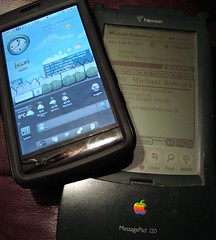
Newton vs Android

Sure, my new Dell Streak (shown overlapping my MessagePad 120 here) is in full colour, has Wifi, 3G and Bluetooth, but neither Android nor iOS replicate some of the core functionality found on a Newton.

I could pull up the notepad screen for instance and write out (in longhand) "Remember Cindy's birthday next Wednesday" and then click the 'Assist' button on the screen to have the Newton open the calendar, scroll to next Wednesday, and create a day-long reminder named "Cindy's Birthday". Other functionality such as customized business card styles on a per-contact basis were very nice for personalizing individual contacts. It understood the difference between business entries ("Microsoft Support") and people ("Bill Gates").

I could start drawing free-hand on the notepad screen and it would interpret the shapes I was drawing -- freehand circles became perfectly round (and had editable edges that could be dragged to accurately fix sizing), lines and other shapes properly aligned and closed, etc.

Do I want to go back to using it for my day to day routine? Of course not, its slow and bulky compared to modern devices. But do I wonder why after fifteen years I don't have functional handwriting recognition and basic AI on my new tablet phone? I sure do.

2011-02-15

Open is better than closed

I like open systems, I prefer them, for a few reasons. I use both open and closed systems by necessity, but I prefer open. If your'e totally lost, in the software and hardware world, we consider platforms and systems to be closed when they're only managed by a private entity. A system is open when it can be changed or edited or modified by anyone. Some systems are also called open because their specifications are fully published and not hidden. This isn't what I'm talking about though.

In this case, the open system of the day is Android's phone and tablet platform. The closed system it takes on is Apple's iOS. Totally ignoring Apple's product for a moment, because you're all aware of it I'm sure, lets look at some interesting things happening on the Anrdoid front.

LG has created an Android phone with full 3D display and true 3D camera with dual lenses. It can create and display full 3D content. Instead of inventing their own competitor to the iPhone, software and all, they were able to just create hardware capable of doing what they envisioned and then modifying Android to understand their hardware.

Elsewhere, Android devices are being made hardened for Military use. This isn't a market most consumers care about, but it allows the Military contractors to use a known platform for their hardware and save effort on that front, while creating something familiar for the soldier.

The argument against open platforms like Android is so-called fragmentation. That the system isn't static, that it changes from device to device. This makes it moderately harder to write software for the system and to maintain the operating system (Android) itself. The benefits outweigh this issue, in my mind.

Will Apple release a 3D camera and display for their iPhone? Perhaps. What if you don't feel like paying for that feature if and when they did? They might make two versions, but then there'd be fragmentation on their platform too. They might force everyone into the 3D version, in which case you lose the cost-saving choice. They might ignore 3D as a platform, and lose you the option of having it.

Personally, I prefer dealing with companies that offer me choices and create devices that entice me personally but also don't limit my options. That means even if an iPhone did everything I wanted it to do, being dependent on Apple to maintain it in the future is a problem for me. As the twice owner of Newton Messagepads, I'm well aware of how Apple maintains products it stops caring about.